For the last nine years, I’ve been mapping how circularity unlocks business opportunities – in the gaps between silos, sectors, and stakeholders.
Doing my best to shift circularity from just “waste reduction” to a systems view of unlocking a better way forward for business – helping organisations do what they do best: solving problems and realising value in new ways.
Making Circularity Work is a reader-supported publication. To receive new posts and support my work, consider becoming a free or paid subscriber.
2026 is shaping up as a year of momentum.
If I’m honest, I’m just not entirely sure of its direction.
But I’m definitely sensing speed, endurance, and forward motion in the air – in confidence reports, in the energy building towards change, and yes, even in the zodiac charts pointing to a year of acceleration.
But I’m also sensing we have more to let go of.
Because, before organisations can move faster at the pace required, they need to do one thing first:
let go of what’s no longer working.
For me, this is the practices, the purchases, policies and ways of working that deliver more harm than good.
And that’s actually the hard bit.
Perhaps this is the year we shall overcome the mental models holding us back from realising value in new ways that regenerate, not degenerate?
Where progress gets stuck
Despite the ambition I see across boardrooms, offices, and project plans, making progress on the problems that matter still feels harder than it should.
Not because leaders don’t care, or aren’t aware – but because the real problems businesses now face no longer sit neatly inside job descriptions, departments, organisations or even single industries.
They live between them.
Between finance and sustainability. Between roles and processes. Between businesses and their suppliers, partners, and competitors. Between industries like infrastructure, housing and food production. Between organisations and local government. Between producers, consumers, and their communities.
And so when the meeting or conference ends, it’s not on anyone’s to‑do list to solve the “in‑between”.
Most organisations are still structured and resourced for a world where problems can be solved in isolation. It might feel easy to work on something alone, but from what I’ve seen, you won’t solve the problem, nor unlock the opportunities worth progressing.
That way of working is no longer fit for the complexity of today’s challenges, because systems hold our problems in place and the real leverage points sit in the liminal spaces between past, present, and future.
“The entrepreneurs who will matter most in 2026 and beyond are not narrow sector specialists; they’re boundary‑spanning problem‑solvers who operate in the gaps between institutions, knitting together technologies, policies, and communities that were never designed to align.”
I’ve had the privilege of working on those “in‑between” problems – by helping organisations shift from linear, emission-heavy ways of operating to circular.
I got the ‘job’, not because there was a clear path to follow, but because there wasn’t.
They trusted me to find the path forward and bring the right people along on the journey to make it possible.
A complex problem, no clear path forward, and a group of people interested to learn, and they need a guide to light a path forward.
Someone who walks beside them, not in front or behind.
That’s where I am most comfortable. For me, it’s the eye of a storm.
It takes systems thinking to make this real, and that’s where I have learnt in practice, about what’s needed right now.
As a strategist who has worked across a wide range of industries and clients, I identify the patterns emerging and start to question why and what's next. I frame problems within the system to activate agency and investment, co-design solutions to unlock a mindset for ‘learning by doing’ and build the commitment needed for bold ambition when facing the headwinds.
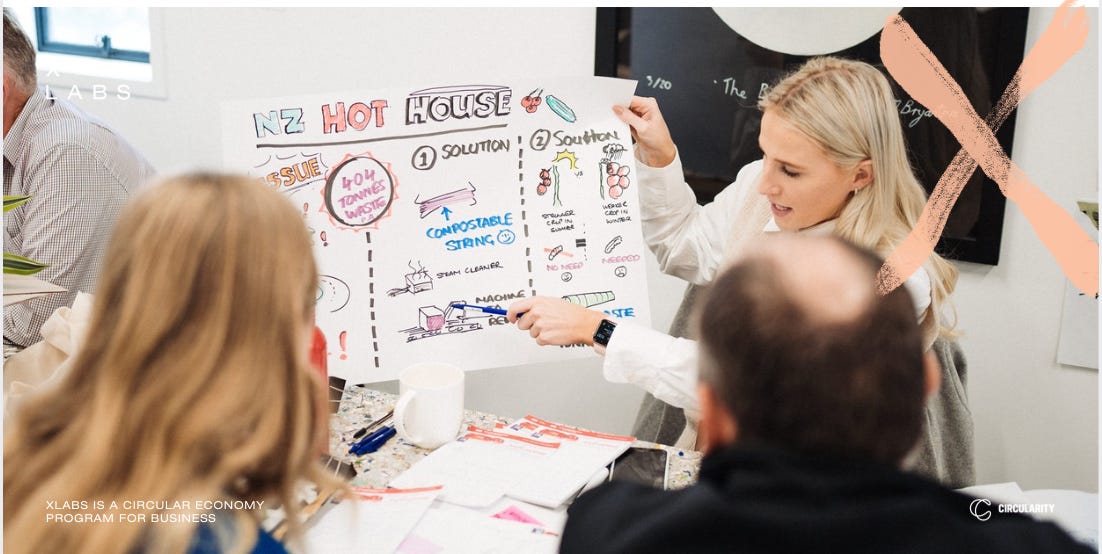
I saw this breakthrough for Zespri to advance its climate commitments when its supply chain partners came together at our XLabs innovation labs 2023 - 24. We helped them create a shared learning of the challenges and opportunities to reduce fruit waste, emissions from the cool chain and regenerative practices of biochar for soil health. Before that, there was no format for them to go on the journey together to explore the risks, nor the potential. It took trust, commitment and the building of new relationships to let go of perceived competitive barriers in order to unlock better outcomes by working together.
I’ve seen firsthand that the transition towards circularity has become imperative for the future of business and nature.
We simply don’t get a healthy, low-emission, equitable future without addressing the extraction of the earth to create products that last seconds or contain harmful materials that pollute our oceans, soils and ourselves
Businesses that ignore this are now a liability to their shareholders and customers alike.
We need a redesign - who is working on that?
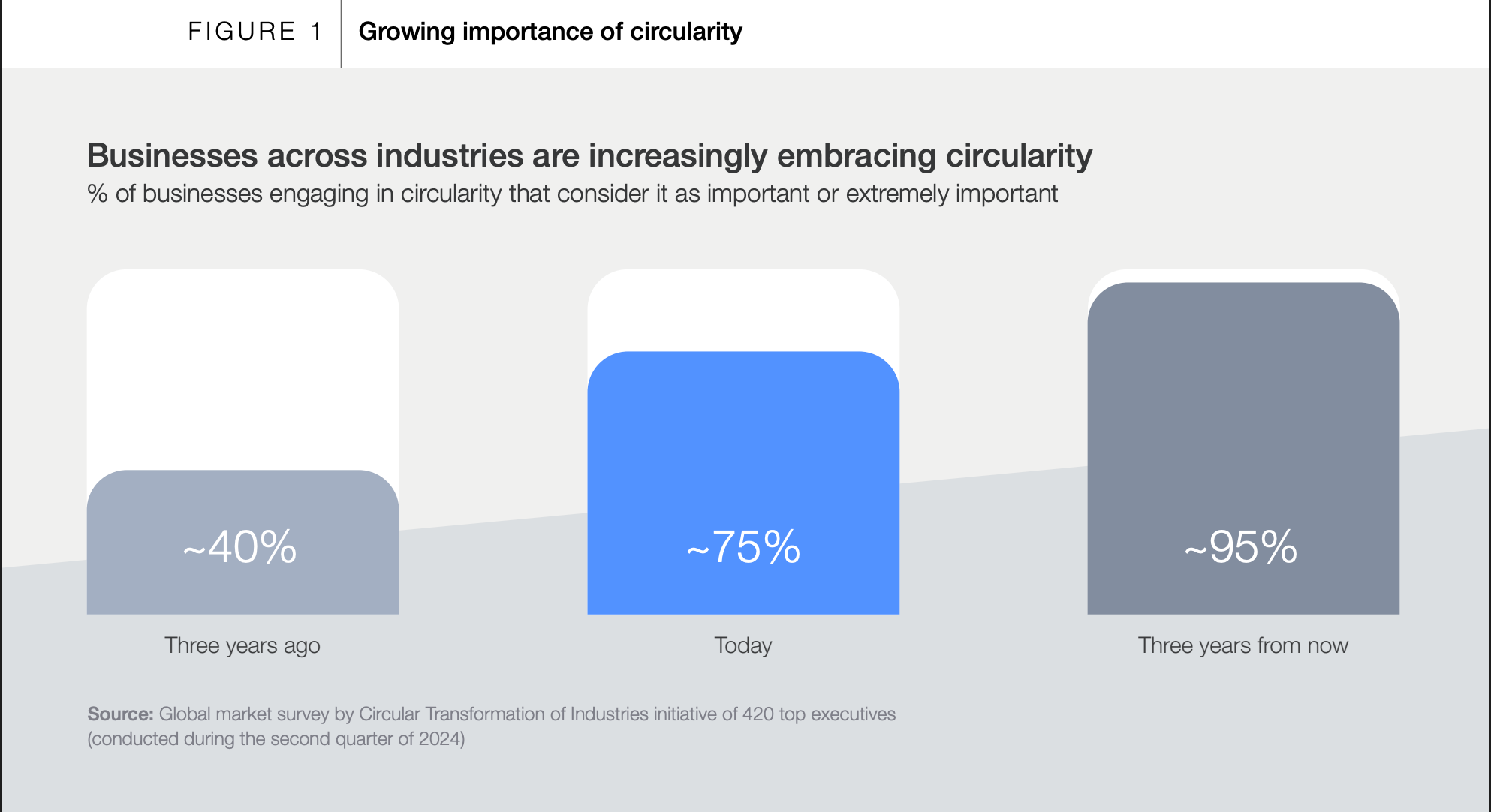
“The climate crisis and unsustainable resource consumption are existential threats to the planet and to the long-term productivity of businesses and industries. At current rates, humans are consuming 1.8 times more natural resources than the Earth can replenish each year. This overconsumption will, sooner rather than later, drive supply shocks and shortages of key materials.”
I see this most clearly at the intersection of the innovation and sustainability work I do.
Ambition is high. Pressure is rising.
But systems, structures, and capabilities haven’t caught up.
Leaders are wrestling with cost pressure, supply chain fragility, climate risk, talent constraints, and regulatory uncertainty – challenges that are deeply interconnected and cannot be solved by one function, one business, or one industry alone.
Yet most organisations are still structured for exactly that.
This holds back meaningful progress on new business, new product development, and bold engagement with markets and stakeholders. Strategies stall. Pilots don’t scale. Partnerships sound like a good idea, but fail in practice – not because the ideas are wrong, but because no one owns the space between.
Research from Harvard Business Review suggests organisations that approach work as projects and programs can drive better outcomes with greater productivity, which mirrors my experience across 160+ circular projects.
I’m often working independently, leading these projects, adjacent to the system that holds the problem in place. I’m looking for the 12 system leverage points that will enable the problem to be solved, and I hold space for organisations to stay accountable to a roadmap we co-design together, across horizons and outcomes.
Business leaders are using circularity to ‘unlock’ future opportunities
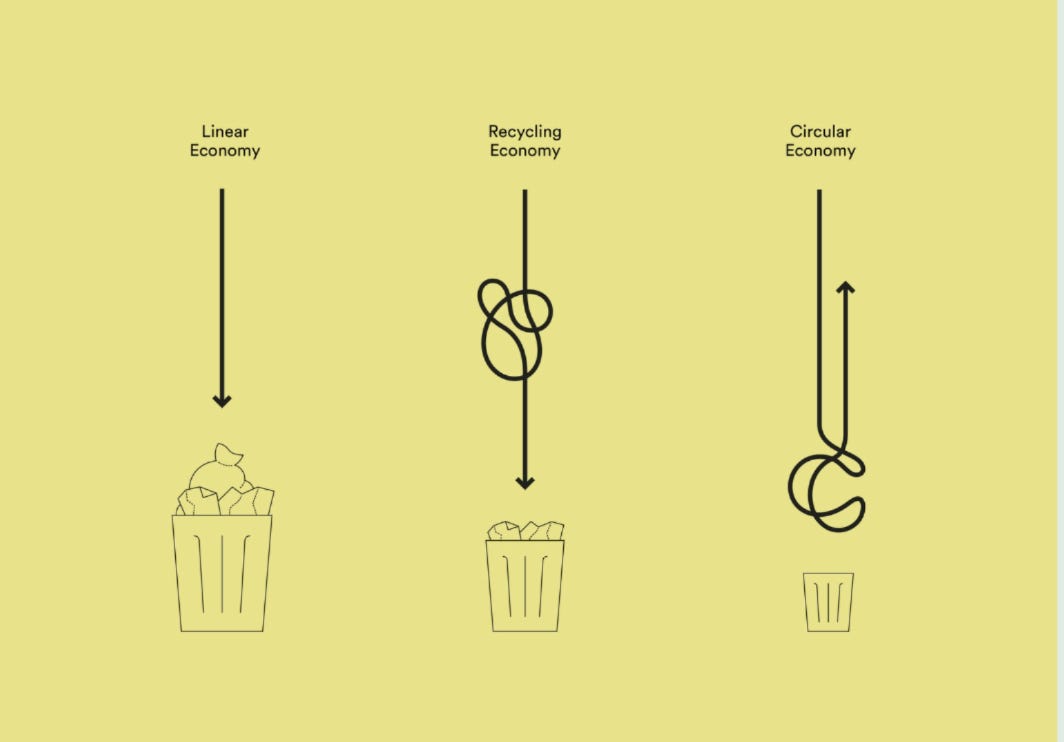
Circularity is often misunderstood as just a technical or environmental fix – something to do with recycling, waste, or “green” operations. But that just kicks the problem down the road, and we lose the opportunities it presents.
Many are also allergic to the description of our economy as ‘circular’.
Let’s get over it.
Because in reality, circularity helps organisations to:
Activate agency in leaders with a systems view of their organisation
Reduce material and cost volatility
Identify new revenue streams, partnerships, and innovation
Build more resilient supply networks
Increase productivity across value chains
Build trusted ecosystems to test new ideas
Work with nature, not against it
Achieve climate goals
The Ellen MacArthur Foundation has consistently framed the circular economy not as a niche sustainability project, but as a new economic model – one that decouples growth from finite resource use, designs out waste and pollution, and regenerates natural systems.
That’s why leaders like Nike, Air New Zealand, Profile Group, Bonson, Phillips, Unilever, IKEA, Foodstuffs, Silver Fern Farms, and Patagonia have embedded circularity across procurement, product design, packaging and operations, unlocking measurable commercial and environmental benefits.
It’s quickly moved from a bolt-on strategy to a built-in one.
For Phillips, their ‘lighting as a service’ circular strategy became so big that they formed a separate company called Signify, now turning over €5.8B in sales by unlocking the gap ‘in-between’ capex/opex, design/operations for its customers.
Shifting from product silos to service ecosystems.
That framing aligns strongly with what I see on the ground:
Circularity as a blueprint for resilient, opportunity‑rich business, not just a compliance exercise.
Working alongside leaders like:
Bonson: exploring the shift to a RePlay, a reusable model, unlocking the gap in a business model that currently rewards single-use procurement.
Profile Group: exploring the gaps between company PnL’s that hide the overall costs of plastic packaging that is used to protect aluminium as it is transported across manufacturing processes, before it arrives at the home wrapped in a blanket.
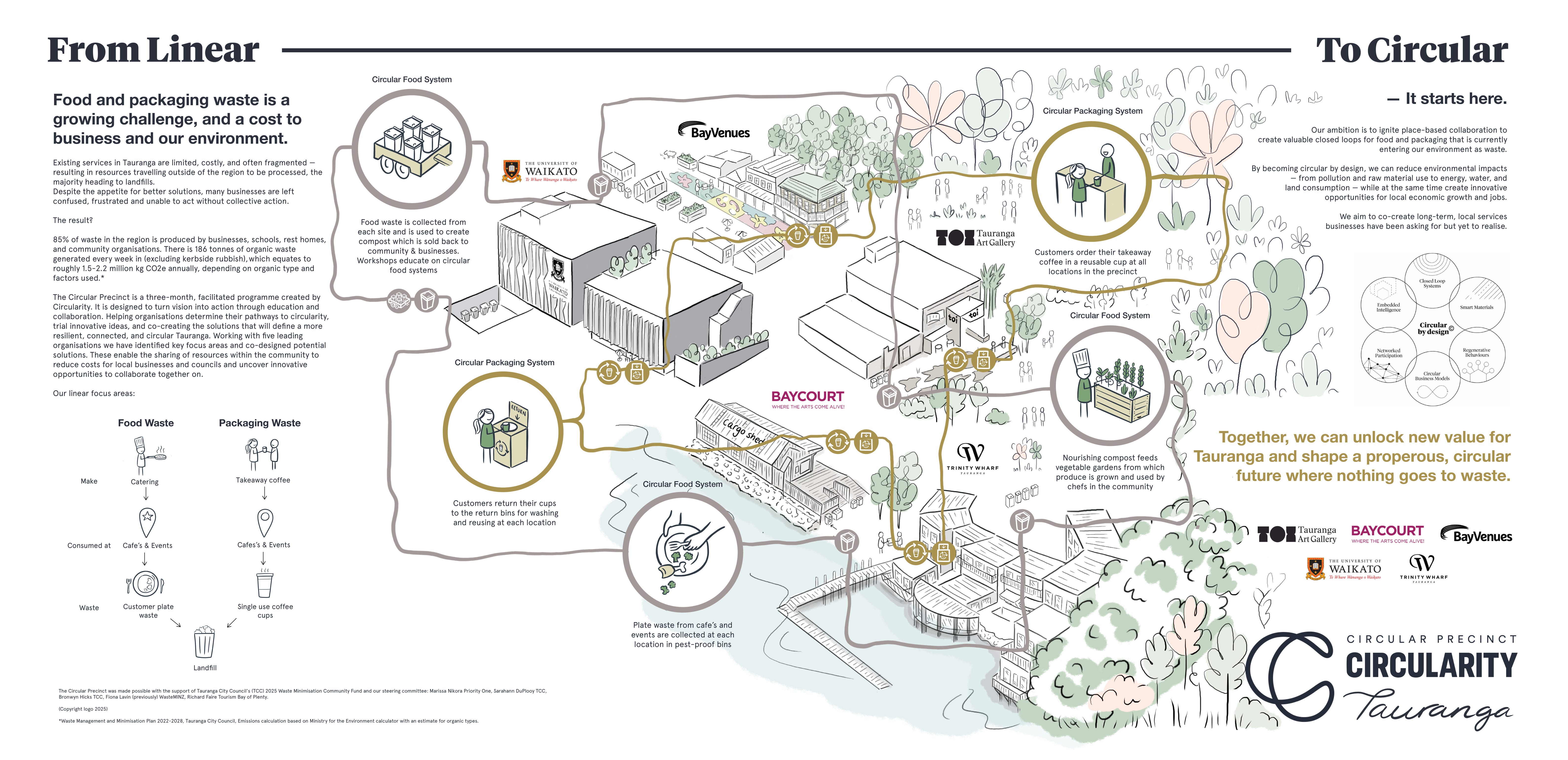
Tauranga City Council: exploring the opportunities in the gap between household waste services and those for businesses, which are taking valuable resources outside the region to landfills.
I’ve seen these organisations gain the strength and capability to move forward quickly, no matter what future challenge comes their way.
Futures Expert Indy Johar identified this as: Civilizational Optionality: the breathing room that keeps futures open when shocks compound and our fates are systematically coupled.
I’m digging in to see how this continues to play out.
When you design for circulation and regeneration, you start considering all stakeholders – including nature – and you build momentum to solve bigger problems and realise more value than money alone.
And that’s exactly what we need.
It’s a repeatable, scalable, and effective strategy to deploy across every area of a business – from procurement to innovation and back again.
So you can learn once, and reapply again and again.
Working alongside Uno Loco to tackle food waste at large-scale events, our unlock was shifting mindsets with inspiring, practical resources for caterers and event organisers. Identifying the constraints of feeding large corporate groups with variable timeframes and solving them with new incentives and processes.
They can now apply this new circular food system model to the food waste challenge at every future event.
Changing the system is a team sport.
I’ve often been asked about how we scale circularity.
That’s precisely why we took up the challenge to design XLabs, our circular economy training program for teams – recently recognised at the COP30 Business Climate Action Awards as the only Aotearoa initiative acknowledged for building business capability to act on climate. With over 23,000 people reached through its programs and the potential to save over 1 million tonnes of resources from landfill with the solutions designed across $5 billion in expenditure, it shows that circular capability can be scaled, embedded, and turned into a tangible business advantage.
Equally, I’ve applied this approach in projects across packaging, food, textiles, and the built environment, following a circular‑by‑design methodology:
System mapping to unearth the problems worth solving
Running sprints to test solutions with teams
Connecting dots across product design, supply chains, and operations
Building the capability and processes to do it again and again
The outcomes speak for themselves:
Millions in cost avoidance and improved material efficiency
New revenue streams from under‑utilised assets
Partnerships and solutions that actually scale
Teams empowered to turn ambition into action, not just strategy
Alongside Samantha Walmsley-Bartlett, this same logic has been applied to unlocking Circular Precincts for local governments. Igniting place-based collaboration to create valuable closed loops for food and packaging that is currently entering our environment as waste.
Working draft for our circular systems in the Precinct. Not for distribution outside this article. Illustration by Elise Motalli.
Why this matters commercially in 2026
Where do I see this heading?
Circularity is no longer “just sustainability.”
It’s something quite different.
It’s a commercial risk and opportunity.
It defines a business within its planetary boundaries, because that is where materials come from.
Either our economy or nature.
But to make it work, someone has to own the work that sits between:
Strategy and execution
Sustainability and finance
Innovation and operations
Businesses and their partners
Reporting and actual projects
The question for every CEO and board member isn’t “should we act?” anymore.
It’s “Who is responsible for making this real?”
Recent research from Joya A. Kemper et al on circular transitions, highlights the role of orchestrators – leaders who can connect actors across the system, set shared purposes, negotiate trade‑offs, and bridge the gap between policy and practice.
We’re seeing job advertisements for these roles increasing across Europe, the US and Australia.
The latter is signalling the ambitions for businesses to step into these opportunities:
80% resource recovery by 2035
30% increase in material productivity (keeping materials in use longer) by 2035
Phase out problematic plastics and implement waste export bans
I’m seeing more industries and countries understand the risks of a dependency on linear material extraction to meet the needs of their citizens now and into the future.
This is the very real inefficiency of 100 billion tonnes of resources extracted from the earth every year, with less than 7% ever cycled back for reuse. Responsible for half the world’s emissions and the largest contributor to biodiversity loss.
For many businesses, though, the context of this risk hasn’t been defined yet - that’s where I start.
Then we’ll start to see the system you’re operating in and a world of possibilities to explore. When we do that, we will be co‑designing the approach, adapting the systems, and shaping the value it creates for the business and the wider ecosystem, including nature.
Nature teaches us that context matters.
Circular work is no different.
An invitation to leave you with
For me, 2026 is the year where circularity steps out of the “nice to have” corner and becomes a core way of doing business – a way to unlock progress where it’s currently stuck, especially in the spaces between teams, roles, supply chains and partners.
To tackle the system challenges we never get to, like low productivity, demand for critical materials, inequitable value creation, meaningful work, or even just shit products that end up in landfill after one use.
That’s why I need you.
No matter what role you find yourself in today.
Consider what’s no longer working or acceptable.
Question why your progress on making a difference is stuck.
And what it would mean to have a running mate beside you.
Identify an area of your business or industry that needs this.
For your business or industry, maybe circularity isn’t just about reducing waste.
Maybe it is, or that’s where you start.
But just maybe, you’re seeing what I’m seeing:
Circularity is about building the adaptive, resilient, regenerative capability that you’ll need for whatever comes next.
So let’s find the gaps worth working on and unlock the way forward to work with nature, not against it.
That’s a conversation I’d welcome.
From anywhere in the world.
📩 louise@circularity.co.nz
Making Circularity Work is a reader-supported publication. To receive new posts and support my work, consider becoming a free or paid subscriber.